Monsignor Douthat’s remit as Opus Dei operative in American Life is to patrol the wombs of American women, to prattle on about ‘out of wedlock births’ the Mortal Sin of abortion and the general Moral Decline, as some of the obsessions of ‘Conservative Thought’. But don’t forget the Opus Dei specialty of, that dovetails with the American Puritan Tradition, the search for the heretics within the body of believers. The Salem Witch Trials and the Spanish Civil War are stark object lessons in that commonality, no matter how starkly antithetical that relationship may appear- one a seeming project to eradicate evil agents of the devil from a religious body,based solely on ‘Spectral Evidence’, and the other to eradicate the souless political agents of Communism from the political body, to engage in reductivism. Monsignor Douthat now continues that tradition of the search for and the eradication of the heretical, on an intellectual plane, with his ‘The Myth of Cosmopolitanism’. He opens his essay with this paragraph:
Now that populist rebellions are taking Britain out of the European Union and the Republican Party out of contention for the presidency, perhaps we should speak no more of left and right, liberals and conservatives. From now on the great political battles will be fought between nationalists and internationalists, nativists and globalists. From now on the loyalties that matter will be narrowly tribal — Make America Great Again, this blessed plot, this earth, this realm, this England — or multicultural and cosmopolitan.
Followed by this telling self-description of his status as a member, in good standing, of a elite free of the taint of the cosmopolitan contagion
Well, maybe. But describing the division this way has one great flaw. It gives the elite side of the debate (the side that does most of the describing) too much credit for being truly cosmopolitan.
He thereby establishes his credibility, as an objective commentator on the heresy of that cosmopolitanism. Followed by a lengthy and utterly self-referential not to speak of self-serving definition of what that cosmopolitanism is, beginning here :
Genuine cosmopolitanism is a rare thing. It requires comfort with real difference, with forms of life that are truly exotic relative to one’s own. It takes its cue from a Roman playwright’s line that “nothing human is alien to me,” and goes outward ready to be transformed by what it finds…
Monsignor Douthat continues his scattershot attack on his chosen targets of the heresy of Cosmopolitanism, in it’s various iterations, garnished with jejune personal references, a list of marginal Literary authors , the high political melodrama of the Brexit, yet the absence of even a mention of the name Kant demonstrates/secures the Monsignor’s status as incurious American Provincial.
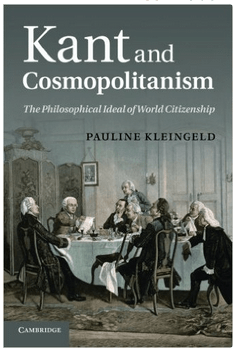
I can think of at least one current book on Kant and Cosmopolitanism: Pauline Kleingeld’s Kant and Cosmopolitanism, The Philosophical Ideal Of World Citizenship as a most valuable commentary/evaluation and compact source, of the latest scholarly explorations of Kant’s idea of cosmopolitanism:
American Writer


 StephenKMackSD's Blog