Political Observer on the virtue of ‘The Catch Phrase’, and other exploitable ‘Thought Forms’?
Sep 04, 2025
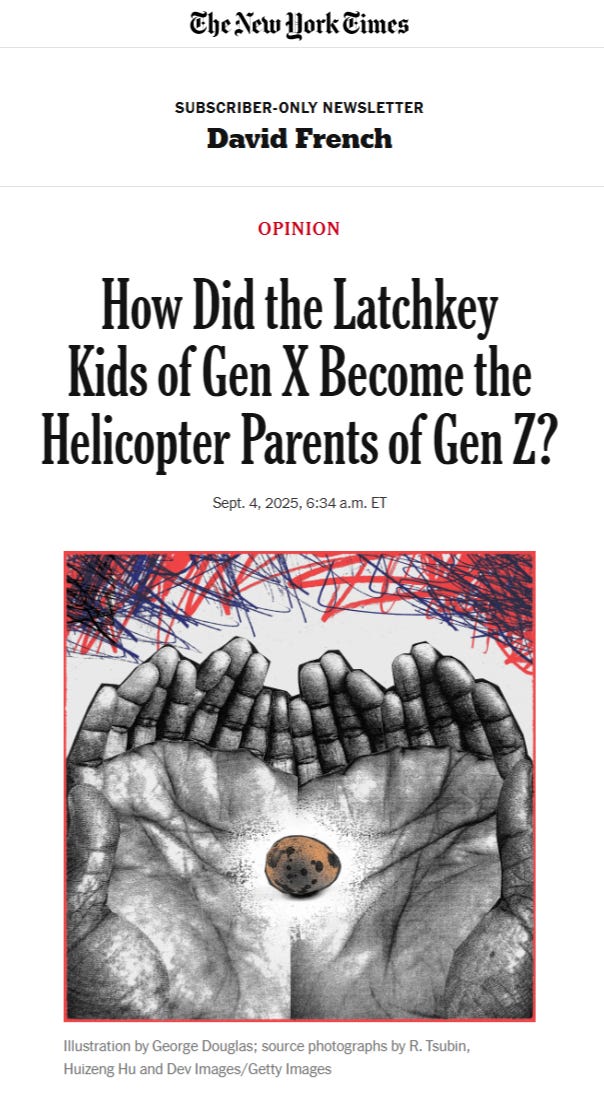
It’s early on a January morning in 1979, I’m 10 years old, and the adventure is about to begin.
My alarm jolts me awake. Snow is falling outside, and my mother tells me that school is canceled. We canceled school every time it snowed in Kentucky, and for me, that was always the best possible news. I grab my winter gear, scarf down some Cheerios, and then I’m off. “Bye, Mom,” I say. “I’m going to Brent’s house,” and that’s the last she sees of me for about 10 hours — until I’m home for family dinner.
The day starts with a pickup hockey game on a frozen pond in our neighborhood and then moves to snow football in Brent’s backyard. We play for hours, and we’re almost ready to go inside for some hot chocolate when we hear the ultimate siren song for a young boy’s brain — go-karts racing in an open field.
We run over and beg to take turns competing on a makeshift dirt track, driving as fast as we can for as long as we can. No one wears helmets. No adults are in sight. And then, with our fingers and toes so cold that we can barely feel them, we hobble back inside — just in time for dinner.
“How was your day?” my mother would ask. “Fun,” I’d respond, and I’d regale my family with tales of my athletic exploits. I’d smooth out the rough edges. I wouldn’t tell them about the minor fistfight over late tackles in the snow football game, or the fact that Jeff drove one of the go-karts into a tree (he was fine; there was only a little blood).
I’d end the day exhausted, happy — and praying fervently that the snow would keep falling. I lost our snow football game, and I needed to get my revenge.
…
French’s essay blossoms, like a thirty minute black and white television Family Comedy, via an esatz Sociological Study… Reader think of David Brooks ‘The Road to Character’ & ‘The Social Animal’ merde!
…
My memory tracks the story that Gen X likes to tell about itself. We’ve been called the least-parented generation in American history, with some justification. It’s not just that we were free-range kids — given permission to roam our neighborhoods at will. Then, independent childhoods were the norm. But we were also the first peacetime generation that grew up with two working parents as a normal part of life, and we were the first generation to live with the consequences of widespread divorce and single parenting, which at that time meant almost entirely single mothers.
In other words, we weren’t experiencing fantastic adventures as much as many of us were experiencing loneliness and abandonment. All across America, young kids would get off their school buses, unlock their houses and fend for themselves for hour after hour, until Mom or Dad came home from work. We were, in the phrase that launched a thousand newsweekly covers, latchkey kids.
My parents exerted tremendous efforts to make sure that one of them was home when my sister and I came home from school, so my latchkey experience is measured in weeks and months, not years, like it was for many of my friends.
For me, the experience was benign, fun even. I was too much of a rule-following nerd to get into real trouble. So my life during those afternoons after school mainly consisted of challenging my neighbor Rob to chess matches and one-on-one basketball games.
…
Editor : Reader prepare yourself for an avilanch of 1548 words, even Newton’s third law of motion is dragooned! Mr. French’s ‘essay’ is deserving of a stinging retorical brevity!
Political Observer.
Editor: In lieu of actual Sociology, Mr. French engages in a New York Times version, pionered by David Brooks? Not to forget that French trades in the territory of Philip Wylie of another time, place and discusive framing, that puts the blame Generationaly, rather than on ‘Momism’. The Reader might ask is there a propinquity?
The Man Who Hated Moms: Looking Back on Philip Wylie’s “Generation of Vipers”
Wylie’s moms were middle-aged and menopausal Cinderellas, hirsute and devoid of sex appeal.
By Peter L. WinklerAugust 13, 2021
…
Generation of Vipers (whose full title is Generation of Vipers: A Survey of Moral Want • A Philosophical Discourse suitable only for the Strong • A Study of American Types and Archetypes • And A Signpost on the two Thoroughfares of Man: the Dolorosa and the Descensus Averno • Together with sundry Preachments, Epithets, Modal Adventures, Political Impertinences, Allegories, Aspirations, Visions and Jokes as well as certain Homely Hints for the care of the Human Soul) sold terrifically when it hit bookstores in January 1943, thanks to the endorsement given it the week before publication by popular columnist Walter Winchell. The first printing of 4,000 copies sold out in a week, and the book just kept selling. Vipers went through 11 printings in 1943 alone and went on to sell 180,000 copies in hardcover by 1954. In 1950, the American Library Association named Generation of Vipers one of the 50 most influential and important books of the last 50 years.
“Mom,” Wylie begins the chapter “Common Women,” “is an American creation. Her elaboration was necessary because she was launched as Cinderella.” Here Wylie refers to an earlier chapter in which he explained how American women were inculcated in a distorted version of the fairy tale that conditioned them to expect material wealth, not because of virtuous activities but merely because they were female. “The idea women have that life is marshmallows which will come as a gift — an idea promulgated by every medium and many an advertisement — has defeated half the husbands in America,” Wylie wrote. “It has made at least half our homes into centers of disillusionment. […] It long ago became associated with the notion that the bearing of children was such an unnatural and hideous ordeal that the mere act entitled women to respite from all other physical and social responsibility.” He went on:
Past generations of men have accorded to their mothers, as a rule, only such honors as they earned by meritorious action in their individual daily lives. Filial duty was recognized by many sorts of civilizations and loyalty to it has been highly regarded among most peoples. But I cannot think, offhand, of any civilization except ours in which an entire division of living men has been used, during wartime, or at any time, to spell out the word “mom” on a drill field, or to perform any equivalent act.
This was an example of the sort of “Megaloid” mom worship that Wylie dubbed “Momism.”
…
Editor: The Discursive Generational Framing.
Greatest Generation (1901-1927), the Silent Generation (1928-1945), Baby Boomers (1946-1964), Generation X (1965-1980), Millennials (1981-1996), Generation Z (1997-2012), and Generation Alpha (2013-present).
Political Observer.


 StephenKMackSD's Blog